
Teaching at an International School in Thailand: Is it right for you?
Please note: this Asia travel blog uses affiliate links. If you click on a link and make a purchase or a booking I may receive a small commission at no extra cost to you. Please see my ethical publishing statement and my full affiliate disclosure.
Teaching English in Thailand changed my life and it might just change yours too. Moving to Thailand at the age of 24 was one of the best decisions I ever made, and scary as it was – it opened my eyes to the world of teaching abroad. Here is what you need to know to decide if teaching at international schools in Thailand is right for you.
I’ve been teaching in schools in Bangkok for 10 years, have tons of friends who are teachers and I’ve worked at both language schools and international schools here so I’ve got a range of experience. While I always enjoyed teaching at home in the UK, my experience of teaching in Thailand was such an improvement in terms of lifestyle. I came here and felt adventure, excitement and freedom like I never had before!
Part of that was to do with being single for the first time in my adult life (!), but the rest was definitely the magic of Thailand.
If you are feeling burnt out, underpaid or underappreciated at home the teaching at international schools in Thailand could be the change you need and I’ve written a moving to Thailand guide to help you.
I’m sharing my personal experience of teaching at an international school in Thailand, including daily life, contracts, holidays, benefits, housing and career progression and why I love it so much!
Teaching at an international school in Thailand can be an incredible career move, but it is not the same as taking a casual TEFL job. The salary, benefits, workload, qualifications, contracts, and expectations vary massively depending on the school. After 10 years teaching in Bangkok, including both language schools and international schools, here’s what I’d want you to know before accepting a role.
Is International School Teaching in Thailand Worth It?
For qualified teachers, international schools in Thailand can offer strong salaries, excellent benefits, good holidays, private healthcare, smaller classes, and a much better lifestyle than many teachers have at home. But the experience depends heavily on the school. You need to check qualifications, salary scale, housing allowance, health insurance, visa support, contract terms, workload, and staff turnover before accepting
Types of International Schools in Thailand
Now, within Thailand, there are so many different international schools. So we have lower tier ones and we have some of the top tier schools. Lower tier ones, you’re probably limiting yourself to a certain salary. They might be ones that accept more inexperienced and newer teachers. In my ebook I’ve listed the top tier schools, particularly in Bangkok that you will want to work for, especially if you are a highly qualified teacher looking for career progression in Thailand.
The Thai government has been tightening down on qualifications required for international schools. So definitely check with the school that you’re applying for, make sure that your qualifications match, because they won’t be able to employ you or they might try and push you into doing another qualification that might not be the one you want – always make sure any new qualifications are globally recognised.
There is a boom in international schools in Thailand, actually across Asia I believe now. So there are going to be so many options coming. It is a great time to be in teaching! However, it is also a great time to make sure you are researching your school really well. Ask to talk to current teachers and make sure you’re going in with your eyes open. You have various different teaching options in Thailand.
Requirements for International School Teachers in Thailand
For me as a British teacher, to work at an international school I was employed in my international school with a DELTA and it is a master’s equivalent. However, since being there, I have completed an IPGCE, which is a Postgraduate Certificate of Education, and I also achieved QTS, Qualified Teacher Status. This is a big one for British schools.
There is going to be an equivalent for all home countries. One of my American friends just completed the equivalent of an iPGCE in the US, but did it from within Thailand. So there are definitely options for getting further qualifications once you’re in with a school as well.
My school provided some resources towards each of my qualifications, both financially and with providing me with a mentor from school, which was just fantastic. It was one of the best things for CPD and it really improved my teaching. That is one of the good benefits of a good school. So definitely ask what your options are for furthering your career at the school that you’re applying for.
At the lower tier schools, there are going to be fewer options, less money put towards it and potentially a higher turnover of staff. So these are all things to really think about before taking a job at an international school in Thailand. You can ask me about the best international schools in my free and private Facebook group.
Continuing professional development has been encouraged at both my Thailand schools. Over the last 8 years in Thailand this means that I achieved the following 3 qualifications:
- DELTA, one of the top EFL qualifications, equivalent to a Masters degree but practical.
- IPGCE, an international qualification to teach in British international schools.
- QTS, Qualified Teacher Status, a UK teaching qualification.
Some people think you can’t advance in your teaching career unless you are living in your home country.
As I’ve shown above, this is completely untrue and I have been very successful in advancing my teaching career while working in Thailand.
Please note I am British and teach at a British school so my qualifications reflect that. If you are a US teacher then you will be able to gain qualifications that are the equivalent. My American teacher friends have done just that.
Daily Life at International Schools in Thailand
Daily life as an international school teacher in Thailand is quite different to language schools. If you are not an early bird, then be warned, international schools start early in Thailand. We usually have to be in school at around 7am. Lessons start from between 7.30 and 8am but the school day also finishes early, around 2.30pm or 3pm for most schools.
The working hours start very early at international schools in Thailand. I have to be at work by 7.15 every day. But then we also can leave early depending on meetings and additional marking work etc. So that is definitely something to bear in mind. It is something I’ve had to really change because I’m not an early bird, and I’ve had to deal with that in the time that I’ve been here, trying to switch my circadian rhythm around a bit.
The school day usually has a break and a lunchtime and you may be required to do supervision duty a couple of times a week. Some schools have extra meetings and activities you can or are obliged contractually to take part in after school but that is usually not every day.
These are usually not on every day and often align with a hobby that you love. For example at my school you can be involved in marine conservation, rock climbing or many different sports.
The workload I feel is quite manageable. In all teaching jobs you are going to experience paperwork that has nothing to do with your teaching role. I found the additional paperwork in both my jobs in Thailand to be a lot less than I would be obliged to do when I was working in the UK.
Planning your move to Thailand?
Join our private (& free!) Facebook community for realistic advice, budgeting help, and a troll-free space to ask questions before you move.
Join our supportive Facebook group here
Class Sizes and Students at International Schools in Thailand
Class sizes, international schools tend to be really small. At my school, the most that we accept is 22 in a class. However, I know friends at other schools that have way less, particularly with the younger years and kindergarten. They will only have up to 15 students in a class.
Lovely, lovely students is the first thing that comes to mind. I’ve had amazing connections with my students in Thailand, from Thai nationals to international students. They are sweet, respectful and very polite. Teaching here means generally minimal behavioural management compared with teaching in the UK or the US. Families encourage their children to learn English and it is seen as a positive and enjoyable thing to do.
One downside I found at the beginning, especially in the language classroom, is that some students were very reluctant to speak. Some assumed that they would need to be quiet for the whole class and suggested that as a classroom rule!! Clearly if we are practising speaking skills that is not what I want, so it can take some encouragement to get students chatting in English, but that motivation is part of the challenge and when you get them talking it’s wonderful!

Salaries at International Schools in Thailand
There are so many different types of international school that the salary range can be really, really broad. On the lower end, we could be talking similar to some of the language schools that I talked about. On the higher end, people can be earning the same amount that they would be earning in London, but you are earning it in Thailand, where obviously the cost of living is so much more affordable.
The top international schools in Thailand pay similar salaries to those in your home country. That means you can live in Bangkok and earn the same salary as you would in London. That means a serious amount of disposable income when you know the cost of living in Thailand is low and that London is insanely expensive.
You can earn anything from 30,000 baht a month (approx £708 GBP / $923 USD) to 200,000+ baht a month (approx £4,725 GBP / $6,154 USD) depending on the school and your experience and qualifications. The lower end tend to be language schools or Thai schools but international schools usually start from 70,000 baht
To make that clearer, salaries at international schools in Thailand often depend on:
- Your qualifications (for example DELTA, IPGCE, QTS or equivalent)
- Your years of classroom experience
- Whether the school is lower tier or top tier
- The city and area of Thailand where you are teaching
Some schools may allow negotiation of salary whereas others will not. Both schools I’ve worked at had a teacher salary scale depending on qualifications and years of experience so it was fixed and not negotiable. Others may be more flexible so it does not hurt to ask.
Work Out Whether an International School Salary Works for You
A good international school package is not just the headline salary. You need to look at housing allowance, rent, transport, insurance, flights home, bonuses, savings, travel, and how much you actually want to spend day to day.
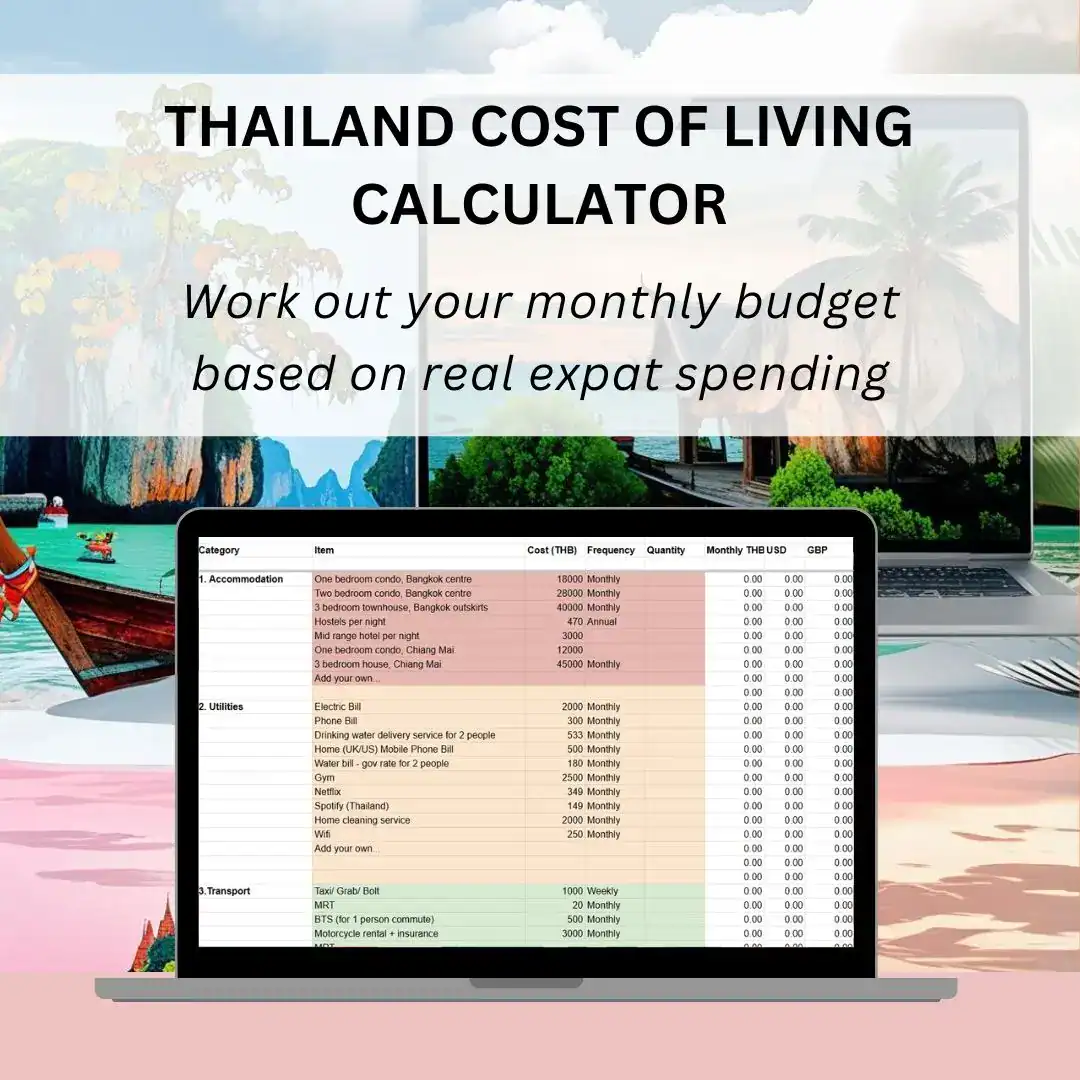
Before accepting a job offer, use our Thailand Cost of Living Calculator to check whether the salary and benefits support the lifestyle you want in Bangkok or elsewhere in Thailand.
Benefits as International Teachers in Thailand
Some of the top tier international schools have some really fantastic benefits. Some of them will offer a yearly flight home or a flight every two years, depending on your contract. Very often, contracts are two-year contracts. That is something that surprised me a little bit when I first started working at an international school. There are often bonuses on completing your contract. This is a really good way, I think, of motivating your staff to stay.
There are some horror stories out there of schools trying to keep people’s passports. Do not give people your passport other than for the necessary immigration paperwork.
You need to be holding your passport where possible. This is another thing that’s really important for me. If there was ever an emergency at home, I need to have my passport on hand. So just once a year when my work permit needs renewal, that is when the school will take my passport.
Getting a visa for international school teachers in Thailand
Your school should handle your visa situation and you will need documents like passport, police clearances from every country you’ve lived in and qualification certificates (the hard copies). You will then be issued a non immigrant B visa and a work permit and likely need to go to a Thai embassy outside of Thailand – in your home country or another country instead.
Work permits, very often the school will keep them and it is a good idea to take a picture of one. You often need it to apply for bank accounts and you can always take it out from the school for things like that. But it is a big headache if you lose your work permit, so that is why most schools prefer to keep the work permits. So that is not a red flag, that is a very normal thing, that they will keep hold of the teachers’ work permits.
In general, benefits packages at international schools in Thailand can include:
- Annual or every two year flights home
- Completion bonuses at the end of a contract
- Visa and work permit arranged and paid for
- Good health insurance, sometimes including dental
- Housing allowance separate from your salary
Disclaimer: I am not a visa agent or a lawyer. Please discuss with your school the terms of your visa and work permit.
Health Insurance and Private Healthcare
The health insurance at international schools, even some of the lower tier ones, can still be really, really good. I’ve had some friends even get dental included in their insurance, which is amazing. That is not in mine, so I’m a little bit jealous. But things like that should be absolutely covered. You should be able to access the top private hospitals in Thailand.
At the moment, I’m on a 10 percent copay through my international school. So I pay 10 percent of everything up to I think 50,000 baht (approx £1,180 GBP / $1,540 USD). So it is never going to be absolutely extortionate in terms of what I have to pay for healthcare.
Thailand is a great place for private healthcare. There are huge amounts of medical tourism in Thailand. Lots of people come here for special surgeries, for specific things. So you do not need to worry about being well looked after in Thai private hospitals. They feel like hotels and you are treated very nicely as long as you’ve got the money to pay or you’ve got the insurance to cover it.
Recently my partner had to rush to hospital (he’s okay now) but they insisted on seeing his insurance paperwork before even letting us through the door – literally. We were standing by the taxi until he could find the email showing he had insurance coverage. It’s so important to make sure schools cover you.
Housing Allowance for International Teachers in Bangkok
Another thing that a lot of the international schools do, which I haven’t found so much with the language schools, is that they will give you a housing allowance. So there will be an extra portion of your salary that is to go towards housing. Many of the schools say a certain amount and then if you rent somewhere that is less, you can bank that difference. So that is really generous of the schools. It is just one of the really nice benefits and shows appreciation for the teachers.
Even for teachers on lower salaries, many still enjoy being able to afford living alone in a one bedroom apartment with a condo pool, regular international travel and not feeling limited by finances. Thailand is a total game changer for this.
In the UK, in expensive cities like London, rent can be even half of your salary at times and it is not affordable to live alone. I had no idea before I moved to Thailand solo the first time that I could afford my own place with a rooftop pool and gym.
As an international teacher in Bangkok, this has meant:
- Being able to live close to the BTS or MRT
- Having access to condo facilities like pools and gyms
- Being able to save or spend extra on travel, depending on the season of life I am in
Holidays at International Schools in Thailand
Holidays for international schools are generally fantastic. Most likely, a lot of my friends at different international schools from mid-tier to top tier get around three weeks at Christmas time, one week February half term. Some schools allocate more weeks for February because it is often around Chinese New Year. Very often you will have between six and eight weeks off during the summer holidays.
Many schools have extensive holidays with usually 3 weeks for Christmas holidays, breaks in half term such as October and February and a long summer holiday of 7 to 8 weeks. I spend most of mine island hopping around Asia (favourites are Indonesia, the Philippines and the Maldives), or seeing wildlife in Sri Lanka or India. I usually go home to the UK twice a year too – for Christmas and for weddings in summer!
Additionally Thailand has many public holidays so you can expect several long weekends over the year as well. In my experience schools are really good at releasing the holiday calendar in advance so that you can get planning your next trip.
Some lower tier international schools may require teachers to teach a summer school, so that is something that you should ask about. I know some schools say in your first year teach the summer school and then you get the whole summer off from the second and third year following, so that is definitely something to inquire about.
Extracurricular Activities and School Community
There is very likely to be some kind of expectation around extracurricular activities. So there might be requirements at your school to run an after school club, run a lunchtime club, go on school trips. I found this actually to be one of the lovely things about school because I’m involved with a lot of our student community teams and it is about causes that I really care about.
For example, I’m very into the ocean. I’m involved in the Marine Conservation Group at my school. We actually take students scuba diving and to do marine research, which is just incredible. I’m also now involved in one of the animal welfare groups where we’re helping stray cats in Bangkok.
So while for some teachers they might find it a bit of a drag to have to do some ECAs, if you can see if it can be something that aligns with what you love and what you’re passionate about, and how you can transfer that over to the students, that can be honestly so, so rewarding.
Is Teaching at an International School in Thailand Right For You?
Teaching at international schools in Thailand has absolutely transformed my life. I have been able to build my career, gain respected qualifications, live in a city I love and enjoy a lifestyle that was never available to me as a teacher in the UK.
You will probably love teaching at an international school in Thailand if:
- You are happy with early starts in exchange for earlier finishes
- You enjoy building strong relationships with students in smaller classes
- You want real career progression and funded CPD while living abroad
- You value good holidays and time to travel during the year
- You want to live in a place where teachers are respected
If you are thinking about becoming an international teacher in Thailand, make sure you research your school, ask the right questions about salary, benefits, visas and workload, and talk to current teachers where possible so that you can go in with your eyes open.
Next Steps
Before you accept an international school job in Thailand, don’t just look at the headline salary.
A strong package can include housing allowance, flights home, private health insurance, bonuses, visa support, and CPD funding. But those benefits only matter if they match the life you actually want to build here.
For example, a salary that feels amazing on paper may look very different once you factor in your rent, commute, food habits, weekend trips, flights home, savings goals, insurance copays, and whether you want a simple lifestyle or a more comfortable one.
That’s why I always recommend working out your own numbers before signing a contract.
I’ve built my real Thailand expat spending into a calculator so you can test your own lifestyle, compare different salary offers, and see what teaching in Thailand could actually afford you.
How Much Will Your Life in Thailand Really Cost?
Work out your likely monthly budget in 15 minutes based on our real spending as US/UK expats living here for 9+ years – then tailored to your lifestyle.
✔️ Estimate your monthly costs based on your lifestyle
✔️ Adjust rent, food, travel, drinks, hobbies, bills
✔️ See totals in THB, USD, and GBP
✔️ Private, editable, and yours for life
Find out if you can actually afford to move to Thailand — before you book flights or sign a lease
Instant access via email. Secure checkout via Payhip with PayPal/Stripe and Google/Apple Pay
If you are still doing your teacher research, then join the community first
Join our private (& free!) Facebook community for realistic advice, budgeting help, and a troll-free space to ask questions before you move.
Join our supportive Facebook group here
